Available for pilots
The AI-native control room for networks full of solar
Real-time control, outage restoration and DER orchestration in one console, the jobs the industry calls SCADA, ADMS and DERMS. ozari+ advises every shift and never operates.
Why now
The network now runs in both directions
Rooftop solar and home batteries changed what a distribution control room must see and do.
36%
Suitable NEM dwellings with rooftop solar, with about 600,000 households now holding batteries.
Capabilities
Everything a modern control room needs
Built as one system, so alarms, outages, switching and automation share one model, one safety gate and one audit trail.
Live single-line
Schematic and geographic views with live energisation. Click to inspect, right-click to operate. Every value carries a quality flag.
Alarm management
ISA-18.2 performance metrics: alarm rate, floods, chattering and standing alarms. Critical alarms cannot be shelved.
Switching and safety tags
Switching orders and crew clearance tags that block control. Tags are checked again just before a device moves.
Outage management
Outages, affected customers and crews in one place, with live SAIFI, SAIDI and CAIDI.
Self-healing (FLISR)
Locates a fault, isolates it and restores supply through a tie. Advisory by default. It will not restore until isolation is confirmed.
Volt/VAR optimisation
Coordinates capacitor banks against voltage limits. Storm mode arms self-healing and volt/VAR together.
DER management
Holds feeder export under a hosting limit and trims backfeed that causes over-voltage, with the least possible curtailment.
State estimation and studies
A voltage state estimator with bad-data detection, plus switching-order and N-1 contingency studies from the live topology.
Trends and reports
Historian-backed trends with CSV export, and branded PDF reports for operations, reliability, energy and audit.
DER management
Keep export under the limit, with the smallest curtailment
The DERMS optimiser watches reverse flow and voltage on every feeder. It holds export under each feeder’s hosting limit and trims backfeed that pushes voltage too high, curtailing as little as it can.
- Advisory or automatic. Start in advisory mode. Arm automatic mode per feeder when you are ready.
- Interlocked. A tagged device is never dispatched, and a standby server refuses to dispatch.
- Audited. Every curtailment is a recorded command, with who armed it and why.
The voltage effect of curtailment is estimated from the network model.
The console
Designed for long shifts
Fast, calm and dense where it needs to be. Five colour themes and three layouts, from compact to wallboard. Take the tour.
-
 01
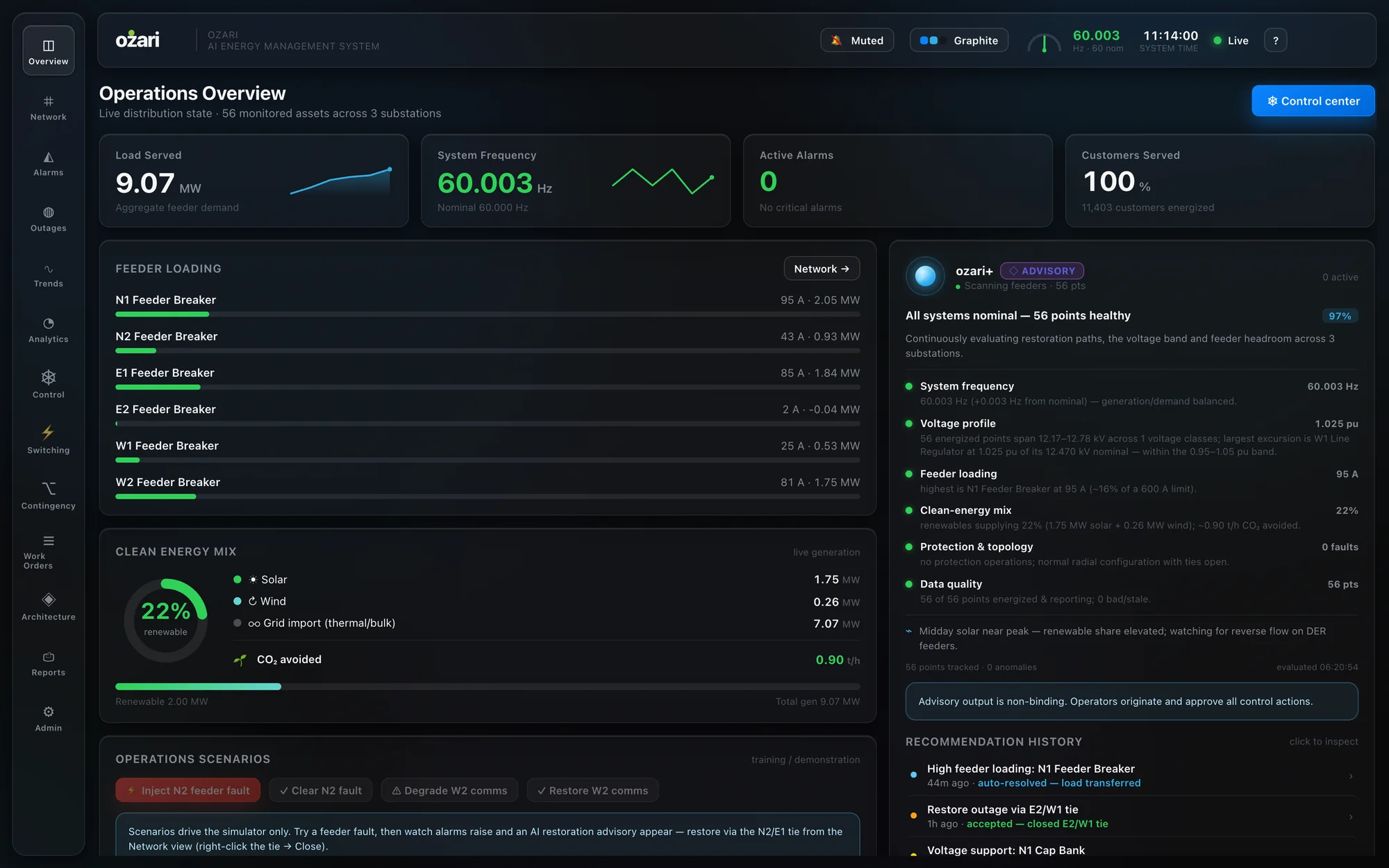
01One operating picture
Load, frequency, alarms and customers served at a glance. On the right, ozari+ sums up the network, shows how sure it is, and lists what it advised before and what happened next.
-
 02
02The network, live
The single-line shows energisation as it happens. Solar and wind feeds are green, and normally-open ties are marked. Click to inspect. Right-click to operate, through two-person approval.
-
 03
03Self-healing, advisory by default
When a feeder faults, self-healing (FLISR) finds and isolates it, then proposes restoration through a tie. It stays advisory until an administrator arms it.
-
 04
04Forecasts you can check
ozari+ forecasts load and generation for the next 24 hours and plots what really happened beside it. Every forecast is scored, so errors are visible.
-
 05
05Every action on the record
Commands, approvals and alarm actions land on a SHA-256 hash-chained ledger. The console checks the chain and shows the result, so tampering is visible.
-
 06
06Nothing hidden
A live view of the control plane: every engine, interface and data flow, with its health. ozari+ runs beside the engines, with no route to the command path.
Screens from the Ozari console, showing simulated data from the Ozari lab network.
Supervised autonomy
Autonomy, earned in stages
Each class of automated action has its own mode. Zones, rate limits and a kill switch apply on top. Everything starts switched off, and ozari+ stays advisory at every stage.
Default
Off
The default. Ozari watches and records, and does nothing on its own.
Mode
Advise
Ozari proposes the action and the reason. An operator raises the command.
Mode
Confirm
Ozari prepares the command. An operator confirms it before anything moves.
Armed
Auto
Pre-authorised by an administrator for a zone. Interlocks, the lease and the audit still apply.
Editions
Pick the scope you need
| Edition | What it includes |
|---|---|
| SCADA | The operations core: live single-line, alarms, commands with two-person approval, safety tags, switching, trends and historian export. |
| ADMS | Everything in SCADA, plus outage management, fault location and restoration (FLISR), volt/VAR optimisation, DER management, state estimation and analytics. |
| AI-EMS | Everything in ADMS, plus ozari+, branded reports, high availability, single sign-on and links to peer control centres (ICCP, lab-grade). |
Honest scope
Not yet. On the roadmap
We would rather tell you now. Ozari Grid does not do these things today:
- Battery dispatch and state-of-charge management. Battery systems can be monitored today.
- EV charging management.
- Market bidding and trading.
- Forecasts driven by numerical weather models.
- Integration with an AMI head-end. Meters are modelled today.
- IEEE 2030.5 (CSIP-AUS), the Australian standard for managing customer solar and batteries. DER control runs through Modbus gateways today.
Start safely
Begin with a read-only shadow pilot
Ozari runs beside your current systems, sees the same data and issues no commands. You measure the value with your own data before anything changes.